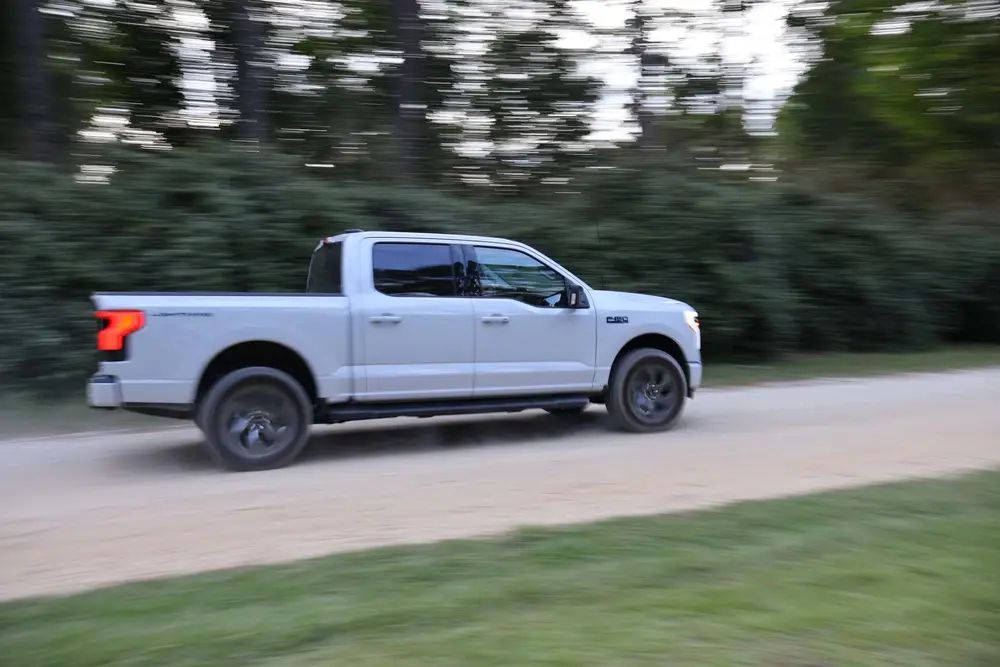
Ford's $19.5 Billion Wake-Up Call: Why the Lightning F-150 Proved a Costly Bet
Ford took one of the largest corporate write-downs in its history related to electric vehicles, signaling that the F-150 Lightning bet hasn't paid off — and forcing a fundamental rethink of the Blue Oval's EV strategy.
Ford’s electric vehicle ambitions hit a wall in late 2025. The company announced a $19.5 billion special charge — among the largest write-downs in its 122-year history — primarily related to its electric vehicle investments. The bulk of that charge, approximately $8.5 billion, relates directly to impairments on EV assets, including the F-150 Lightning program that was supposed to lead the automaker’s reinvention.
The numbers are stark. Ford lost money on every F-150 Lightning it sold. Dealer inventories built up faster than retail demand could absorb them, even after Ford cut production. The truck that was supposed to prove legacy automakers could compete with Tesla in the EV era instead became a case study in what can go wrong when you build a product for a regulatory future that hasn’t arrived yet.
The Lightning’s Problem
The F-150 Lightning, launched in 2022, was genuinely impressive as a vehicle. It delivered 452 horsepower in its standard form and 580 in the Platinum Extended Range variant. The extended-range battery offered 320 miles of EPA-rated range. The frunk was cavernous and genuinely useful. The instant torque and low center of gravity made it surprisingly fun to drive on dirt roads and highways alike.
But the economics never worked. The Lightning’s starting price of approximately $50,000 — before options that could push it well past $70,000 for a loaded Platinum — positioned it as a premium product compared to the conventional F-150, which starts around $35,000. For a truck buyer, that premium required either a specific use case (fleet operators with home charging, off-road enthusiasts wanting the instant torque) or an ideological commitment to electrification that a much smaller subset of buyers actually hold.
Ford reportedly built the Lightning on a modified version of the conventional F-150 platform rather than a dedicated EV architecture — a cost-saving decision that limited packaging advantages but didn’t close the price gap with competitors building from the ground up for electric powertrains.
What Ford Is Doing Now
The $19.5 billion charge isn’t just an accounting entry. It reflects real strategic recalibration. Ford has since announced it will shift development of its next generation of electric vehicles to a new “skunkworks” team in California, working with a fresh architecture designed for cost competitiveness rather than feature leadership. The first vehicle from that program — a midsize electric pickup targeting a 2027 launch — is expected to carry a base price around $35,000.
Ford is also doubling down on extended-range plug-in hybrids under the EREV designation. These vehicles use a small gasoline engine as a generator to extend range beyond what the battery provides — similar to the range-extender architecture used in the BMW i3 REx and the original Volt. The advantage is you get genuine electric driving for daily commutes while eliminating range anxiety for long trips without the weight and cost of a massive battery pack.
Hybrids are getting similar emphasis. The F-150 now offers a standard hybrid powertrain option, and Ford has said it expects approximately 50 percent of its global volume to come from hybrids, EREVs, and BEVs by 2030 — down significantly from the all-in bet on BEVs that characterized its 2021-2023 strategy.
The Broader Industry Lesson
Ford’s difficulties are a microcosm of what the entire legacy auto industry is wrestling with. Building EVs at scale requires massive capital investment in new manufacturing capabilities, new supply chains for batteries and power electronics, and new dealer and service models that differ substantially from the ICE business. The expectation that customers would follow regulators and automakers up the price curve — paying $15,000 to $20,000 premiums for EVs that cost more to build — turned out to be wrong.
The federal tax credit’s elimination for most EVs in late 2025 made this dynamic worse by removing the subsidy that was quietly financing the price gap. Ford and GM can no longer offer vehicles with effective discounts covered by government incentives.
Whether Ford’s pivot — toward more affordable EVs, hybrids, and EREVs — comes in time is the central question for the automaker’s next five years. The Lightning proved that an excellent electric truck doesn’t automatically find buyers. The next truck will need to be an excellent and affordable one.