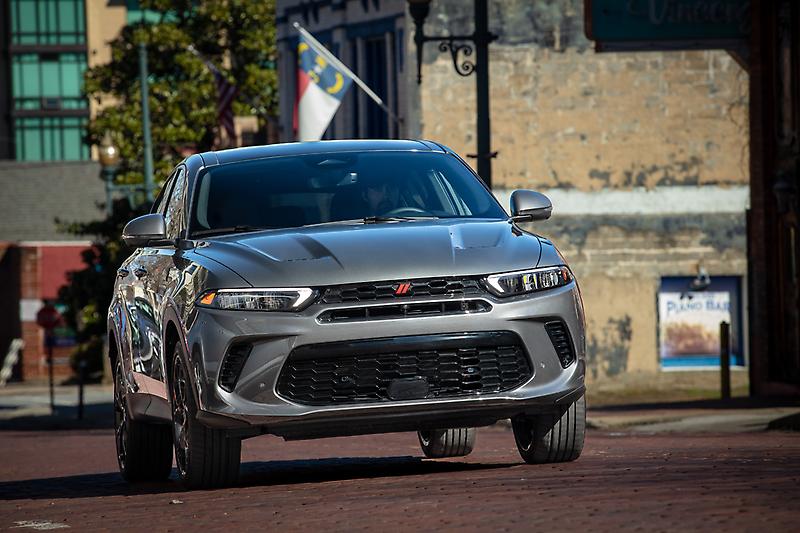
2023 Dodge Hornet: Everything We Know About Dodge's First Electrified Performance SUV
The 2023 Dodge Hornet is the American muscle brand's first foray into electrified performance. Here's everything we know about the specs, trims, pricing, and performance of Dodge's compact SUV.
The 2023 Dodge Hornet arrived as something genuinely new for the American muscle-car brand: an electrified, compact performance SUV that brings genuine horsepower and aggressive styling to a segment dominated by softer, appliance-like crossovers. It’s also Dodge’s first plug-in hybrid, marking the brand’s first concrete step toward the electrified future promised under the Stellantis umbrella.
Unveiled in August 2022 at M1 Concourse in Pontiac, Michigan, the Hornet started arriving at U.S. dealerships in spring 2023. It shares its Giorgio platform with the Alfa Romeo Tonale — itself a stylish compact SUV — but Dodge has worked overtime to give the Hornet a distinct muscle-car personality that the Italian twin can’t match.
Here’s everything we know about the 2023 Dodge Hornet.
Two Powertrains, Two Philosophies
The 2023 Hornet comes in two distinct flavours, and they represent genuinely different approaches.
GT — The Gas-Powered Entry Point
The Hornet GT uses a 2.0-litre turbocharged four-cylinder that Dodge calls the Hurricane 4. It produces 268 horsepower and 295 lb-ft of torque, sent to all four wheels through a nine-speed automatic transmission. This is the only non-hybrid option in the lineup.
EPA fuel economy is rated at approximately 21 mpg city, 29 mpg highway, and 24 mpg combined — unremarkable for the class, but the performance numbers are the draw. The GT scorches from 0–60 mph in around 5.8 seconds, making it one of the quickest compact crossovers under $35,000. For context, the Volkswagen Golf R — widely considered the hot-hatch benchmark — does the same sprint in 4.9 seconds but starts around $43,000. The Hornet GT undercuts it by roughly $13,000.
The GT comes in two trims: GT and GT Plus. The base GT includes the Hurricane 4 engine, all-wheel drive, 18-inch alloy wheels, a 10.25-inch Uconnect 5 infotainment screen with wireless Apple CarPlay and Android Auto, a 12.3-inch digital instrument cluster, heated front seats, and a rear-view camera. Step up to the GT Plus and you add leather upholstery, a panoramic sunroof, a 14-speaker Harman Kardon audio system, and additional driver-assistance features.
R/T — The Plug-In Hybrid Performance Model
The Hornet R/T is the more technically interesting of the two, and it’s the one that signals where Dodge is heading. The R/T pairs a 1.3-litre turbocharged four-cylinder (part of Stellantis’s Global Small Engine family) with a 90 kW electric motor mounted on the rear axle.
Combined output: 288 horsepower and 383 lb-ft of torque. That’s a substantial torque figure — the kind of number that makes launches feel dramatic. The R/T ships with a six-speed automatic transmission driving the rear wheels via the electric motor, while the engine powers the front wheels through its own path.
The 15.5 kWh battery delivers an EPA-estimated 30+ miles of electric-only range, which is competitive with plug-in hybrid rivals like the Toyota RAV4 Prime (42 miles) and Volvo XC60 Recharge (35 miles). In practice, most R/T owners will be able to handle daily commuting on pure electricity. When the battery is depleted, the hybrid system manages engine and motor output for best efficiency.
Dodge’s PowerShot mode is the R/T’s party trick: hold the Sport button for three seconds and the system delivers an extra 30 horsepower for up to 15 seconds. It’s not a true overboost — the underlying hardware is simply unlocking what the battery and motor can briefly provide. The result is a 0–60 time of 5.6 seconds, or closer to 5.1 seconds with PowerShot engaged in ideal conditions.
The R/T also introduces a set of driving modes unique within the Hornet range: Sport (full hybrid performance, max battery deployment), Hybrid (intelligent blend of engine and motor), Electric (rear-motor only, EV-only operation), and E-Save (which conserves the battery for later use — useful if you’re planning to drive through a city centre and want to arrive with a full battery).
R/T and R/T Plus Trims
The R/T is offered in R/T and R/T Plus trims. The base R/T starts at $44,995 MSRP, while the R/T Plus as tested with options came in around $52,305. Both include the PHEV powertrain, all-wheel drive, Koni frequency-selective dampers, Brembo brakes, and the electronic limited-slip differential with torque vectoring as standard.
Performance Hardware: Serious Equipment Standard
One of the most compelling arguments for the Hornet is what you get for the money in terms of chassis and brake hardware — equipment that many competitors charge extra for or don’t offer at all.
Every Hornet comes equipped with:
- Brembo brakes — four-piston front calipers, a meaningful upgrade from the generic stoppers fitted to most compact crossovers
- Koni frequency-selective dampers (FSD) — automatically adjusting shock absorbers that stiffen during aggressive driving and soften for comfort on rough roads
- Electronic Limited-Slip Differential (eLSD) — proactively routes torque to the wheel with the most grip, improving both traction and corner-exit behaviour
- Torque Dynamic Allocation — coordinates power delivery between front and rear axles in all-wheel-drive models
The R/T additionally gets functional hood scoops (feeding air to the intercooler), a unique sport exhaust note, and the PowerShot boost system. The suspension calibration is sportier than the GT’s, reflecting the R/T’s performance aspirations.
Interior and Technology
Inside, the Hornet’s cabin is a significant step up from other Dodge products. The design is driver-focused, with the centre console “tipped” toward the driver — a layout more common in sports cars than crossovers.
The headline technology is the Uconnect 5 infotainment system, running on a 10.25-inch touchscreen. It supports wireless Apple CarPlay and Android Auto as standard, along with built-in navigation, a Wi-Fi hotspot, and over-the-air update capability. The 12.3-inch digital instrument cluster ahead of the driver is fully configurable and displays essential performance data including hybrid system status on R/T models.
The cabin features a mix of sport and premium materials. The GT Plus and R/T Plus include leather-trimmed, deeply bolstered sport seats — comfortable enough for daily driving but supportive enough to hold you in place during enthusiastic cornering. Carbon fibre-look trim and contrast stitching give the interior a more purposeful feel than the muted greys and blacks of mainstream compact SUVs.
In terms of cargo space, the Hornet offers approximately 22.7 cubic feet behind the rear seats — slightly less than the Toyota RAV4 (26.5 cu ft) due to the PHEV battery in the R/T, but competitive with other plug-in hybrid crossovers.
Charging and Practicality
The Hornet R/T’s 15.5 kWh battery can be charged at up to 7.4 kW on a Level 2 AC charger — meaning a full charge takes roughly two to two-and-a-half hours on a 240V home setup. The included Level 1 (120V) cable is slow (overnight for a full charge) but fine as a backup.
On DC fast chargers, the Hornet R/T accepts up to 50 kW — not class-leading, but acceptable for occasional road-trip charging. A 10–80% charge takes around 30–35 minutes on a 50 kW DC fast charger.
Standard safety and driver-assistance features include blind-spot monitoring with rear cross-traffic alert, parking sensors, lane-keeping assist, automatic emergency braking, and adaptive cruise control with stop-and-go functionality on the R/T Plus.
How It Compares
The Hornet’s closest platform sibling is the Alfa Romeo Tonale, which uses the same Giorgio platform and similar powertrains but targets a more refined, European luxury audience. Where the Tonale prioritises elegance and driving refinement, the Hornet leans into aggressive American muscle-car styling and a rawer, more performance-focused character.
Against other compact performance crossovers:
- Volkswagen Golf R: Faster (4.9s 0–60), all-wheel drive only, no PHEV option, starts at ~$43,000
- BMW X1 xDrive28i: Less powerful, more expensive (starts ~$38,000), more luxurious interior
- Mercedes-AMG GLB35: Significantly more expensive (~$50,000+), 302 hp, seven seats
The Hornet R/T occupies a unique niche: the only plug-in hybrid performance compact SUV under $50,000 when it launched. The Volvo XC60 Recharge PHEV (from ~$54,000) and BMW X3 xDrive30e (from ~$48,000) are larger and more expensive.
Design and Styling
Dodge didn’t hold back on the visual message. The Hornet’s exterior design is unmistakably Dodge — and deliberately different from the Tonale it shares bones with.
The front fascia is dominated by a massive hexagonal grille with a honeycomb mesh pattern and, on the R/T, red “Dodge” lettering across the centre. The racetrack-style LED taillight bar connecting the rear lamp clusters is a direct link to the Charger and Challenger “muscle car” visual language. The hood on the R/T features functional air intakes that feed the intercooler, not just for looks.
The overall silhouette is lower and more fastback-like than a typical compact SUV — think of it as a raised hot hatch with a more aggressive posture. The blacked-out roof on certain option packages, the available 20-inch wheels on the R/T Plus, and the aggressive front and rear fascias make the Hornet look like nothing else in its segment.
The interior colour options include a bold red leather on certain trims — a deliberate callout to the classic Dodge muscle car colours of the 1970s and 80s.
Pricing Breakdown
| Trim | Powertrain | Starting MSRP |
|---|---|---|
| GT | 2.0L Turbo 4cyl, 268 hp, AWD | $29,995 |
| GT Plus | 2.0L Turbo 4cyl, 268 hp, AWD | ~$36,995 |
| R/T | 1.3L Turbo PHEV, 288 hp, AWD | $44,995 |
| R/T Plus | 1.3L Turbo PHEV, 288 hp, AWD | ~$49,995 |
Prices are Manufacturer’s Suggested Retail Price as of 2023 and do not include destination charges, options, or dealer fees. Actual transaction prices will vary.
A fully loaded R/T Plus with the Premium Package and options can push past $53,000 — a significant number for a Dodge, but competitive with loaded versions of the Volvo XC60 Recharge and BMW X3 xDrive30e.
What’s the Verdict So Far?
Early reviews from outlets like Car and Driver, MotorWeek, and The Drive have been broadly positive, with consistent praise for the Hornet’s chassis hardware, the R/T’s strong hybrid powertrain, and the aggressive styling that sets it apart. The 5.5-second 0–60 time of the GT and the sub-6-second potential of the R/T are genuinely competitive numbers for the price.
Common criticisms include:
- Firm ride quality: The Koni FSD dampers and sport suspension prioritise handling over comfort — the Hornet is notably firmer than the Toyota RAV4 or Honda CR-V
- R/T’s EV range: 30 miles is adequate but trails the Toyota RAV4 Prime (42 miles)
- No manual option: Despite Dodge’s muscle-car heritage, there is no manual transmission available — even the Alfa Romeo Tonale no longer offers one
- Interior materials: Better than other Dodges, but still trailing the German competition at similar price points
- Infotainment responsiveness: Uconnect 5 is a genuine improvement, but some early testers reported occasional touchscreen lag
The Bottom Line
The 2023 Dodge Hornet is a compelling entry in the compact performance SUV space. The GT delivers genuine muscle-car muscle at an accessible price, while the R/T PHEV offers a genuine electrification story without sacrificing performance. It’s the most interesting thing Dodge has built in years — not because it’s perfect, but because it actually commits to a personality.
The Hornet GT is the smart buy for traditional Dodge fans who want a practical daily driver with genuine performance credentials. The R/T is the forward-looking choice — a plug-in hybrid that can genuinely entertain on a back road, commute silently on electricity, and still haul four passengers and their gear for a weekend trip.
Dodge has confirmed the Hornet’s future beyond 2023 is uncertain due to production and regulatory pressures, but the 2023 and 2024 model years represent a genuine, committed entry in the performance compact SUV segment. Whether you’re cross-shopping a VW Golf R, a BMW X1, or a Toyota RAV4 Prime, the Hornet deserves a test drive.
Related Articles
For more on Dodge’s electrified future, see our coverage of the 2024 Dodge Charger Daytona and our best EV SUVs buying guide.