Solid-State Batteries: The Technology That Will Define the Next Decade of EVs
Toyota, QuantumScape, and Samsung are all pushing solid-state batteries toward commercialization. Here's what it actually means for your next EV.
Every few years, a technology promise comes along that makes EV skeptics pause and EV advocates light up with excitement. Solid-state batteries have been that promise for the better part of a decade. But 2026 feels different — the timeline to actual commercialization has genuinely compressed, and the automotive world is running out of reasons to be skeptical.
Toyota, QuantumScape, Samsung SDI, and a handful of well-funded startups are all on the cusp of bringing solid-state cells to market. Understanding what this means — and what it doesn’t — is essential for anyone buying an EV today or in the next few years.
Why Liquid Electrolytes Are the Problem
To understand why solid-state matters, you need to understand what’s inside most EV batteries right now. Today’s lithium-ion batteries use a liquid electrolyte — a flammable organic solvent that allows lithium ions to move between the cathode and anode. That liquid is why thermal runaway (think: battery fires) is a real concern, and it’s also why fast charging generates more heat stress than batteries would prefer.
Solid-state batteries replace that liquid with a solid electrolyte — typically a ceramic, glass, or sulfide compound. The implications are significant.
The Benefits, Explained
Energy Density
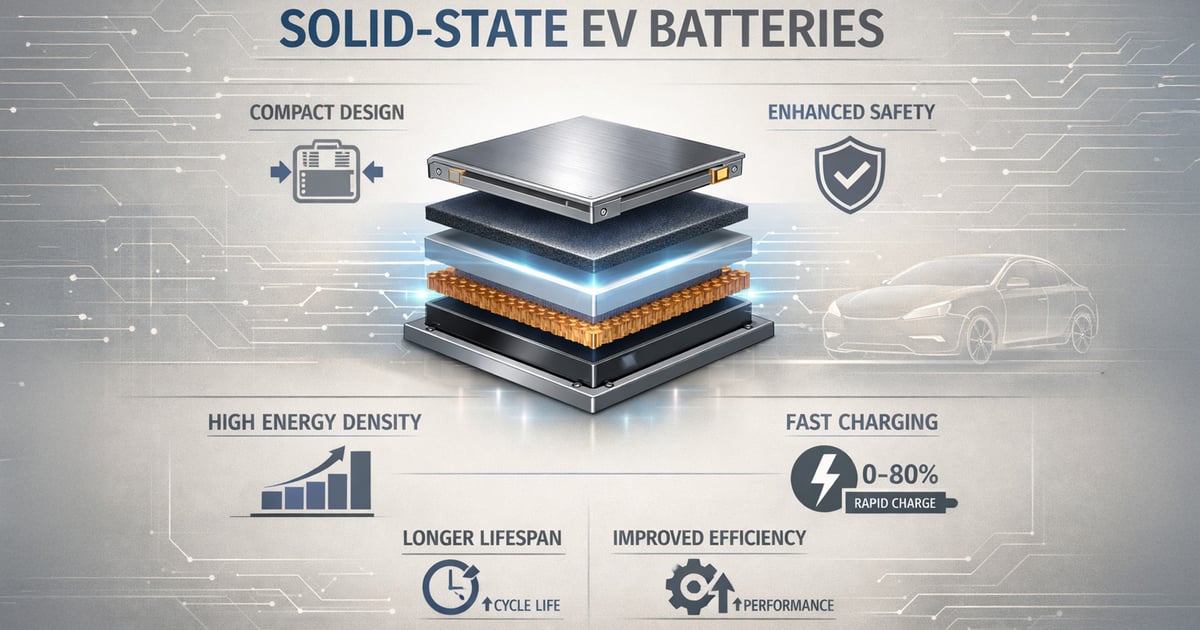
The most cited advantage is energy density. Solid electrolytes allow the use of lithium metal anodes instead of graphite anodes. Lithium metal has roughly ten times the theoretical energy density of graphite. In practice, this could mean a battery pack that delivers 50-100% more range from the same volume and weight.
For context: a 100 kWh liquid-cell pack in a vehicle like the Mercedes EQS might weigh around 1,400 pounds. A solid-state equivalent with the same usable capacity could weigh under 900 pounds. That’s not a typo.
Toyota has publicly stated its solid-state cells target 1,200 Wh/L — roughly twice the energy density of current generation NMC (Nickel Manganese Cobalt) cells.
Charging Speed
This is where solid-state gets genuinely exciting. The solid electrolyte enables much faster DC fast charging without the lithium plating issues that plague current liquid-electrolyte cells. Toyota demonstrated a 10-80% charge in under 10 minutes in lab conditions. If that translates to production vehicles, the range anxiety argument against EVs effectively collapses.
Safety
With no flammable liquid electrolyte, the primary mechanism for thermal runaway is removed. Solid-state cells can be punctured, crushed, or overheated without the cascade of events that lead to battery fires in current EVs. This doesn’t make them immune to failure — but the failure mode is far more benign.
Lifespan
Current liquid-electrolyte cells degrade measurably with each charge cycle, typically retaining 70-80% capacity after 1,000 cycles (roughly 300,000 miles). Solid-state cells show minimal degradation in testing — QuantumScape’s data shows over 1,000 cycles with less than 10% capacity loss in its single-layer cells.
The Players and Their Timelines
Toyota
Toyota has been the most aggressive public advocate for solid-state. The company has filed more solid-state battery patents than any other automaker and has announced plans to introduce solid-state cells in hybrid vehicles by 2027-2028, with full EVs following. A Toyota EV with solid-state batteries and 750-mile range has been teased for 2028.
QuantumScape
Backed by Volkswagen and Bill Gates, QuantumScape is perhaps the most credible startup in the space. The company went public via SPAC in 2020 and has published independently verified test data showing its lithium-metal solid-state cells surviving 1,000+ cycles. QS expects to begin commercial production at its 2026 Gigafactory in San Jose. VW subsidiary PowerCo has licensed QuantumScape’s technology.
Samsung SDI
Samsung’s battery arm has demonstrated a solid-state cell with 900 Wh/L energy density and plans pilot production lines by 2027. The company is supplying BMW, which has announced solid-state batteries for a future i7 variant.
CATL and BYD
The Chinese battery giants aren’t sitting still. CATL’s solid-state roadmap targets 2027 for its first generation, while BYD has hinted at similar timelines. China’s state-backed battery industry has resources and manufacturing scale that could compress costs faster than Western competitors.
The Caveats Nobody Talks About
It’s not all imminent breakthroughs. Solid-state batteries face real challenges:
Cost: Solid electrolytes and lithium metal anodes are expensive to produce at scale. Current solid-state cell costs are estimated at $150-200/kWh versus $80-100/kWh for liquid cells. That gap needs to close.
Manufacturing scale: QuantumScape’s pilot lines produce millions of cells annually — impressive for a startup, but a rounding error versus the billions of cells the industry needs.
Temperature sensitivity: Some solid electrolytes, particularly sulfides, are sensitive to moisture and require dry room manufacturing. This adds complexity and cost.
Cycle life in full vehicles: Lab results are one thing. Real-world performance over 200,000 miles with real-world charging habits remains to be proven.
What This Means for Your Next EV
If you’re buying an EV today or in the next 2-3 years, solid-state won’t be a factor. The first production solid-state vehicles will likely be expensive, limited-run models from Toyota or a premium VW brand. Mass-market solid-state EVs are realistically a 2028-2032 story.
But here’s the thing: the development of solid-state technology is already improving liquid-cell batteries. Many of the same manufacturing advances, electrolyte improvements, and cell-to-pack designs being developed for solid-state are bleeding back into current generation batteries. The Model Y Long Range you buy today benefits indirectly from the billions being invested in solid-state.
The Bottom Line
Solid-state batteries represent the most significant leap in EV technology since the lithium-ion cell became practical for automotive use. The physics is compelling, the test data is promising, and the major players are committing serious capital. If the 2020s were about proving EVs can replace gas cars in daily use, the early 2030s may well be about proving they can do it with half the weight, double the range, and near-zero fire risk.
Shop related reading: If you want to go deeper on the science behind what’s coming, The Battery: The Story of Modern Battery Technology covers the fundamentals of lithium-ion and the road to solid-state in accessible terms.
The wait is almost over. And it’s going to be worth it.